Poorly Diffracting Samples
You may notice that the call from the well-diffracting walkthrough is exactly the same here, minus the --enrich-gate: on weak data a genuine lattice may put only a handful of predicted spots on measurable signal, so a gate tuned for strong shots would throw away real hits along with the noise. Even in poorly diffracting environments, probixi aims to let you get the most from your data, without a speed penalty from low signal-to-noise. Here, we’ll work through an example of C1C2 crystals at the synchrotron.
probixi \
  -i c1c2.lst \
  -g synchrotron.geom \
  -p c1c2.cell \
  -o c1c2.stream \
  --device cuda \
  --gif noise_model.gif
Turning up sensitivity
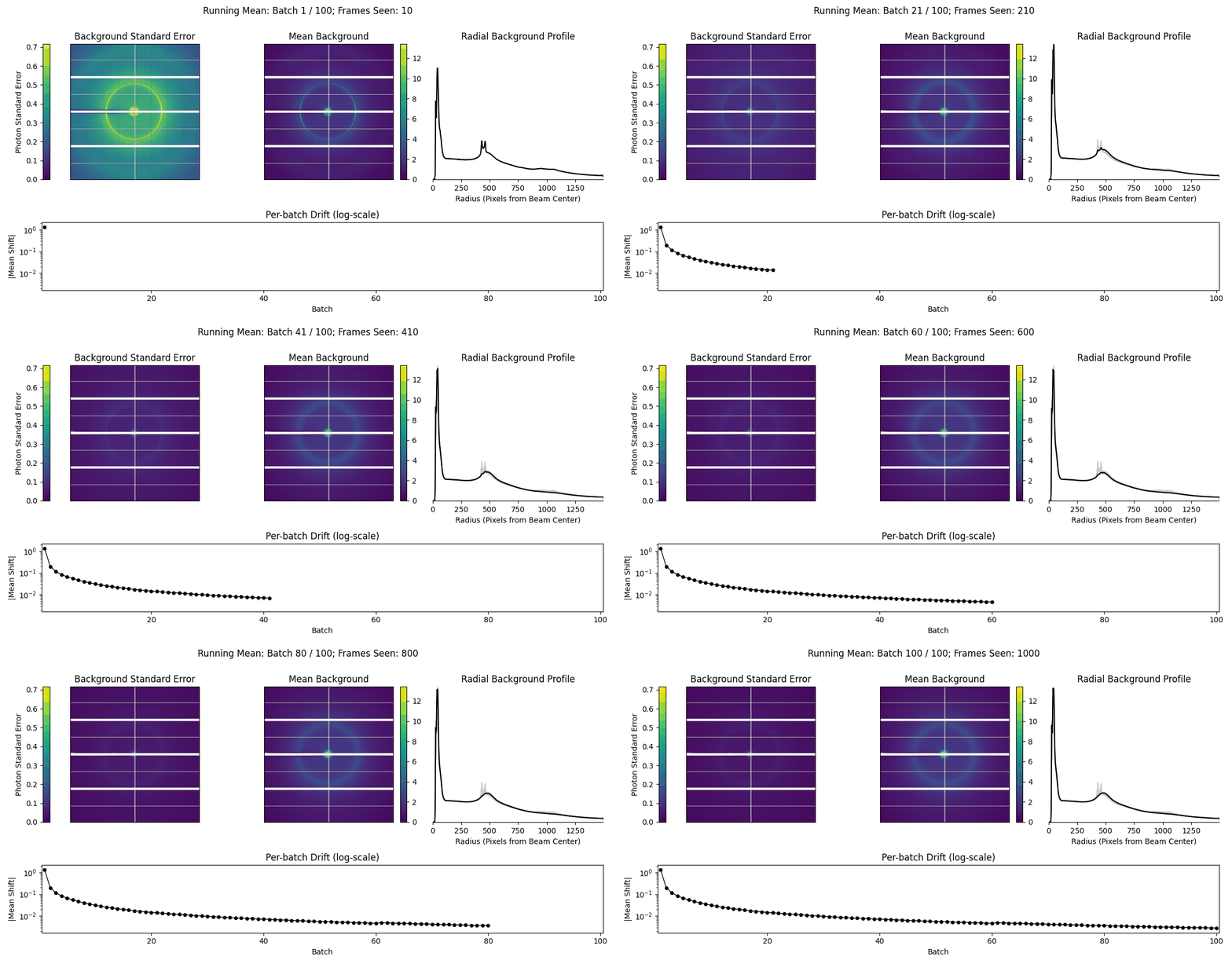
Because weak signal leaves little margin, a clean background estimate matters most. --gif noise_model.gif is the quickest way to confirm the noise model has converged, and calibrating on more frames with --seed-frames steadies it if a hit rate looks lower than expected. The auto-calibrated detection threshold usually handles the rest, but if you do need to push sensitivity harder, --target-noise-peaks raises it by tolerating a few more noise blobs per frame.
NOTE:
--target-noise-peaksis still being tested to ensure you don’t merge more noise downstream
Sparse patterns index themselves
With few peaks, seeding an orientation is the hard part, and it is handled for you. The Fibonacci-sphere seeder adapts per frame: on peak-starved frames it automatically widens the orientation search (at the cost of some computation), more sample directions and in-plane angles, so a sparse pattern still gets a fair shot, then narrows back on richer frames. A candidate must still explain a minimum handful of peaks (six by default) to be accepted, so an information-starved frame simply goes unindexed rather than indexing wrongly.
Since the gate is off, nothing is dropped for weak prediction, but every indexed frame still records its enrichment, n_bright, and enrich_p in the output (see the frames table). If overprediction does turn out to be a concern on a given dataset, you can inspect that distribution and threshold it after the fact.